The
The
The

Newsletter
Newsletter
Newsletter
Search our Newsletter
Sharp insights, marketing strategies, and branding inspiration, delivered once a week.
The Scale Clarity Framework
No spam. Just insights worth sharing.
Recent Issues
The Scale Clarity Framework
The Scale Clarity Framework
The Scale Clarity Framework
Stop Waiting for Your Brand to Happen.
Engineer It.
Stop Waiting for Your Brand to Happen.
Engineer It.
Rare Ideas is a strategy-first branding for founder-led businesses. We turn businesses into brands that scale strategically, visually, and across every touchpoint.
View our portfolio
Healthy is no longer the differentiator.
Healthy is no longer the differentiator.
Healthy used to be the differentiator. Today, it's the expectation.
Walk into the healthier ice cream aisle today and something immediately stands out. Almost every brand is telling you the same story. High protein. Zero added sugar. Low calorie. No preservatives. Read enough packs back to back and the differences begin to blur. Five years ago, these claims felt like innovation. Today, they feel like the starting point.
The shelf looks this way because the category has matured, and its language has matured with it. Healthier ice cream no longer has to convince consumers that it deserves to exist. That battle has already been won. The next challenge is giving consumers a reason to choose one brand over another when everyone is making similar promises.
Healthier ice cream has followed a familiar path.
When Halo Top launched in the US in 2012, it changed the category with one simple proposition: low-calorie, high-protein ice cream that didn't feel like a compromise. By 2017, it had become the best-selling pint in America, proving there was enormous demand for healthier indulgence.
Success, however, attracted imitation. Competitors quickly entered with the same nutritional claims, and what had once differentiated Halo Top gradually became standard across the category. As the market matured, consumer conversations shifted away from calorie counts towards flavour, texture and overall eating experience. A rumoured $2 billion sale to Unilever fell through in 2018, and the brand was eventually sold the following year to Wells Enterprises, a regional ice cream maker, for an undisclosed and reportedly far smaller sum.
The same pattern shows up in ice cream itself. Brands like Van Leeuwen, Salt & Straw and Jeni's, who now lead the category's next chapter globally, don't compete on subtraction. They lead with what they put in single-origin ingredients, small-batch technique, flavours built around a specific place or season which is harder to copy because it's built into the product, not the label.
India's healthier ice cream market is still in its first phase, and the brands building it deserve credit for that work. GoZero has built its entire proposition around one line "Zero on Sugar, 100 on Taste" and used it to become one of the country's fastest-growing better-for-you brands. NOTO and Artinci have built similar ground with their own versions of the same promise. At the same time, the market continues to grow rapidly as healthier indulgence becomes mainstream. Research from Mintel describes this broader shift as permissible indulgence, where consumers no longer see health and indulgence as opposing ideas. They expect products to deliver both.
Once everyone delivers the same functional promise, consumers begin looking elsewhere for reasons to choose.

While researching the healthier ice cream category for a recent project, one insight kept appearing across reports, conversations and consumer reviews.
Across healthier ice cream brands in India and globally, consumers rarely questioned whether products were healthy enough. Instead, the conversation centred around texture, mouthfeel, aftertaste and whether the experience felt like "real" ice cream.
That distinction is worth paying attention to. Health often justifies the first purchase. The product experience determines the second.
Consumers evaluate healthier ice cream against their own definition of what great ice cream should taste like. The benchmark has always been the category itself, not the healthier alternatives within it.
This is also where India presents an interesting opportunity. Much of the healthier food conversation globally has been shaped by subtraction. Less sugar. Less fat. Fewer calories. Indian food culture has traditionally taken a different approach. We have understood ingredients through what they contribute. Ghee, curd, jaggery and millets became part of everyday food culture because of the role they were believed to play, not because of what they removed.
Whether those beliefs are nutritional, cultural or generational isn't the point. They shape how people instinctively think about healthy food. As healthier ice cream evolves, that creates space for Indian brands to build stories that feel culturally familiar instead of relying entirely on global wellness language.
The research points towards one clear shift. For the first generation of healthier ice cream brands, functional claims created demand. For the next generation, functional claims will establish credibility, but preference will increasingly be shaped by everything around the product: flavour, experience, storytelling, cultural relevance and the distinctiveness of the brand itself.
Functional claims help consumers build trust in a product. Preference is shaped over time through the experience the brand consistently delivers.
That has implications beyond healthier ice cream. Every category eventually reaches a point where yesterday's differentiator becomes today's expectation. The brands that continue to grow are usually the ones that recognise that shift before everyone else does.

One of the easiest traps to fall into while building a brand is continuing to invest in the things that customers have already started taking for granted.
Every category has a phase where functional benefits create demand. Over time, those same benefits become the baseline. They don't disappear, they simply stop influencing preference in the same way.
The opportunity is recognising that shift before the market forces you to. Ask yourself: What are the claims every credible brand in my category is expected to make today? Once you've answered that, ask a second question: What can my brand become known for once those expectations are already met? That's often where the next phase of growth begins.
Over the last few months, we've been asking ourselves those exact questions while building a healthier ice cream brand from the ground up. Our research suggested the category had reached a point where subtraction had become the expected language of healthier indulgence. That led us to explore a different question: what happens when you build a healthier ice cream brand around what it adds instead of what it removes?
Next week, we'll share how those insights shaped the strategy, identity and packaging of Get Monk'd.
Healthy used to be the differentiator. Today, it's the expectation.
Walk into the healthier ice cream aisle today and something immediately stands out. Almost every brand is telling you the same story. High protein. Zero added sugar. Low calorie. No preservatives. Read enough packs back to back and the differences begin to blur. Five years ago, these claims felt like innovation. Today, they feel like the starting point.
The shelf looks this way because the category has matured, and its language has matured with it. Healthier ice cream no longer has to convince consumers that it deserves to exist. That battle has already been won. The next challenge is giving consumers a reason to choose one brand over another when everyone is making similar promises.
Healthier ice cream has followed a familiar path.
When Halo Top launched in the US in 2012, it changed the category with one simple proposition: low-calorie, high-protein ice cream that didn't feel like a compromise. By 2017, it had become the best-selling pint in America, proving there was enormous demand for healthier indulgence.
Success, however, attracted imitation. Competitors quickly entered with the same nutritional claims, and what had once differentiated Halo Top gradually became standard across the category. As the market matured, consumer conversations shifted away from calorie counts towards flavour, texture and overall eating experience. A rumoured $2 billion sale to Unilever fell through in 2018, and the brand was eventually sold the following year to Wells Enterprises, a regional ice cream maker, for an undisclosed and reportedly far smaller sum.
The same pattern shows up in ice cream itself. Brands like Van Leeuwen, Salt & Straw and Jeni's, who now lead the category's next chapter globally, don't compete on subtraction. They lead with what they put in single-origin ingredients, small-batch technique, flavours built around a specific place or season which is harder to copy because it's built into the product, not the label.
India's healthier ice cream market is still in its first phase, and the brands building it deserve credit for that work. GoZero has built its entire proposition around one line "Zero on Sugar, 100 on Taste" and used it to become one of the country's fastest-growing better-for-you brands. NOTO and Artinci have built similar ground with their own versions of the same promise. At the same time, the market continues to grow rapidly as healthier indulgence becomes mainstream. Research from Mintel describes this broader shift as permissible indulgence, where consumers no longer see health and indulgence as opposing ideas. They expect products to deliver both.
Once everyone delivers the same functional promise, consumers begin looking elsewhere for reasons to choose.
While researching the healthier ice cream category for a recent project, one insight kept appearing across reports, conversations and consumer reviews.
Across healthier ice cream brands in India and globally, consumers rarely questioned whether products were healthy enough. Instead, the conversation centred around texture, mouthfeel, aftertaste and whether the experience felt like "real" ice cream.
That distinction is worth paying attention to. Health often justifies the first purchase. The product experience determines the second.
Consumers evaluate healthier ice cream against their own definition of what great ice cream should taste like. The benchmark has always been the category itself, not the healthier alternatives within it.
This is also where India presents an interesting opportunity. Much of the healthier food conversation globally has been shaped by subtraction. Less sugar. Less fat. Fewer calories. Indian food culture has traditionally taken a different approach. We have understood ingredients through what they contribute. Ghee, curd, jaggery and millets became part of everyday food culture because of the role they were believed to play, not because of what they removed.
Whether those beliefs are nutritional, cultural or generational isn't the point. They shape how people instinctively think about healthy food. As healthier ice cream evolves, that creates space for Indian brands to build stories that feel culturally familiar instead of relying entirely on global wellness language.
The research points towards one clear shift. For the first generation of healthier ice cream brands, functional claims created demand. For the next generation, functional claims will establish credibility, but preference will increasingly be shaped by everything around the product: flavour, experience, storytelling, cultural relevance and the distinctiveness of the brand itself.
Functional claims help consumers build trust in a product. Preference is shaped over time through the experience the brand consistently delivers.
That has implications beyond healthier ice cream. Every category eventually reaches a point where yesterday's differentiator becomes today's expectation. The brands that continue to grow are usually the ones that recognise that shift before everyone else does.
One of the easiest traps to fall into while building a brand is continuing to invest in the things that customers have already started taking for granted.
Every category has a phase where functional benefits create demand. Over time, those same benefits become the baseline. They don't disappear, they simply stop influencing preference in the same way.
The opportunity is recognising that shift before the market forces you to. Ask yourself: What are the claims every credible brand in my category is expected to make today? Once you've answered that, ask a second question: What can my brand become known for once those expectations are already met? That's often where the next phase of growth begins.
Over the last few months, we've been asking ourselves those exact questions while building a healthier ice cream brand from the ground up. Our research suggested the category had reached a point where subtraction had become the expected language of healthier indulgence. That led us to explore a different question: what happens when you build a healthier ice cream brand around what it adds instead of what it removes?
Next week, we'll share how those insights shaped the strategy, identity and packaging of Get Monk'd.
Where Should Your Brand Be Different?
Where Should Your Brand Be Different?
Founders building a brand today usually hear two pieces of advice that seem to contradict each other. One says you need to stand out because categories are crowded and looking like everyone else is a fast way to be ignored. The other says you need to stay consistent because customers trust what feels familiar.
Both are good advice. The real question is one every founder eventually has to answer: How different should our brand actually be, and where should that difference show up?
That question has been studied for decades. In 1991, social psychologist Marilynn Brewer introduced the idea of optimal distinctiveness, suggesting that people are constantly balancing two needs. We want to belong, but we also want to feel unique. The things we are naturally drawn to usually satisfy both at the same time.
Business research points in the same direction. Strategy scholar David Deephouse argued that companies perform best when they are "as different as legitimately possible." More recently, researchers including Eric Zhao, a strategy professor at Oxford, described this balance as anchored differentiation. The idea is simple. Customers are comfortable with brands that feel familiar in the places where trust matters, while giving them one clear reason to remember them.
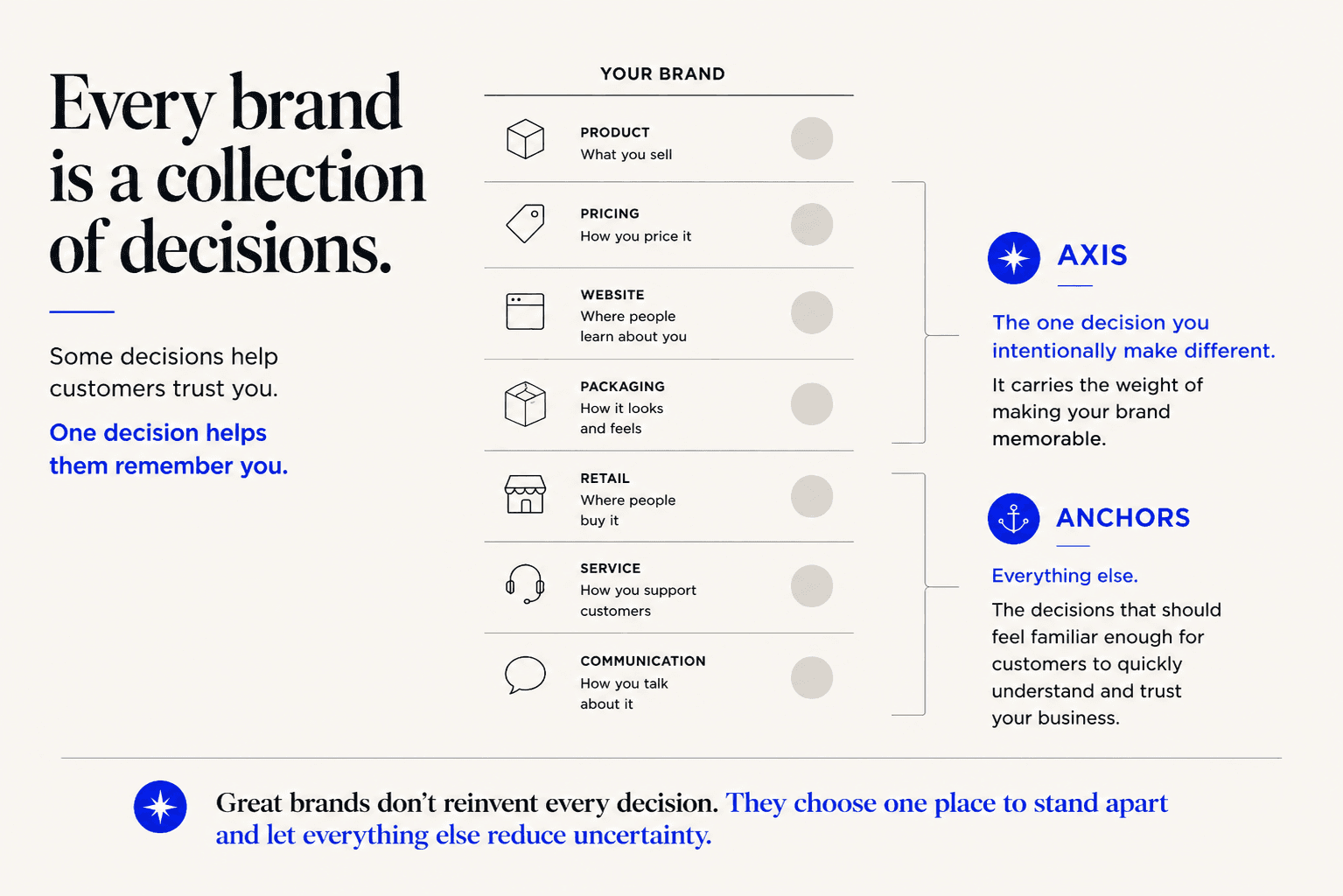
At Rare Ideas, we think about this using a simple lens: Anchor vs Axis.
Every brand has a few decisions that help customers feel comfortable because they match what people already expect from the category. These are the anchors. They could be your pricing, product format, customer experience, retail model or service standards.
Then there is the decision that carries the weight of making your brand memorable. That is the axis. Depending on the business, it could be the product itself, the way the brand communicates, the visual identity or even the way the category is framed.
One important point is worth making here. An anchor does not mean something ordinary or something that deserves less attention. It still needs thoughtful design, clear communication and consistent execution. The difference is simply what it is trying to achieve. Your axis is designed to capture attention. Your anchors are designed to earn confidence.
A growing body of research suggests customers respond best to this balance. Products that look exactly like everything else are often overlooked. Products that look completely unfamiliar can create hesitation because people struggle to place them within the category. The strongest response usually comes from brands that feel familiar enough to understand while introducing one meaningful point of difference.
Mokobara is a great example.
When the founders entered India's luggage market, they decided that product design would carry the brand. Their suitcases introduced bold colours, cleaner forms and details that looked unlike anything else in the category. Many people thought the designs were too unconventional and predicted they would never succeed. The founders ignored that advice and stayed committed to the choices that made the product instantly recognisable, including the now-iconic yellow interior lining.
They were far more disciplined everywhere else. Their pricing sat comfortably between affordable luggage brands and premium international players instead of trying to be the cheapest or the most expensive option. Their positioning remained consistent instead of constantly chasing new stories. They invested in physical stores because luggage is a category where people still want to see and touch a product before buying it. Design became the signature, while every other decision reduced uncertainty for customers.
NOTO approached the same challenge from a different direction.
Healthier desserts had long been presented as compromises. Brands relied on clinical language, functional claims and a visual style that constantly reminded people they were choosing the healthier option. NOTO decided to change how the category felt. Through its visual identity, packaging and communication, it made guilt-free ice cream feel joyful, optimistic and genuinely indulgent.
The product itself remained easy to understand. Customers still bought familiar flavours in familiar formats at prices that competed with other premium ice cream brands. The brand expression changed dramatically, but the product never asked people to learn a new behaviour or rethink what ice cream should be.
Although these brands look completely different, they made remarkably similar strategic decisions. Mokobara chose product design as the place where it wanted to stand apart. NOTO chose brand expression. Neither tried to reinvent every part of the business at once.
It's a principle we believe applies across categories, and one we're putting into practice ourselves.
We went through the same exercise for one of our projects, a healthier ice cream brand still in development. The category has trained people to expect a trade-off: either the product tastes like a compromise, or the branding overcompensates with clinical language to justify itself. Our approach has been to let one ingredient decision carry the weight of being different, while keeping the format, the pricing tier and the retail experience close to what people already expect from ice cream. The goal isn't to make the category feel unfamiliar. It's to give people exactly one new thing to trust.
We'll share more once it's out.
The challenge is that once you've identified where your brand should stand apart, it's easy to let that instinct spill into every other decision as well.
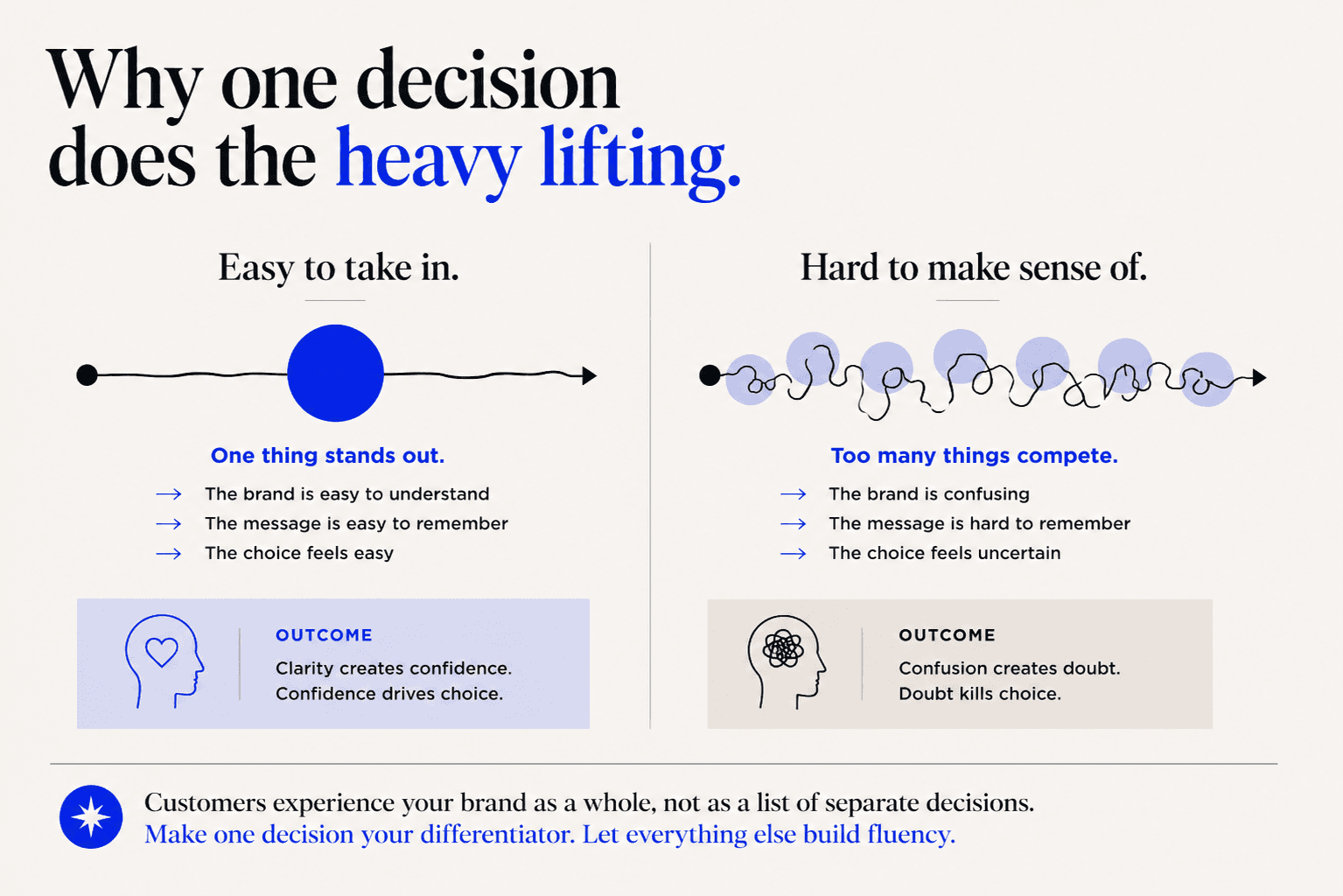
Once founders become excited about differentiation, every decision starts moving in a different direction. The product changes. The packaging changes. The pricing changes. The communication changes. The buying experience becomes another opportunity to be different.
Customers do not process these decisions one at a time. They experience all of them together. Every unfamiliar choice adds a little more work. Eventually, curiosity gives way to uncertainty.
The opposite happens too.
Many brands follow every category convention so closely that customers struggle to remember anything about them. The business feels familiar, but there is nothing that stays with you after the first interaction.
The brands that earn lasting preference usually find a balance between those two extremes. They know exactly where they want customers to pause and pay attention, and they make every other decision to support that moment.
If you are building a brand today, this exercise is worth doing with your team.
Write down the biggest decisions your customers notice. Think about your product, pricing, communication, packaging, retail experience, website, customer service, distribution and anything else that shapes how people experience your business.
Then go through the list one decision at a time.
Which of these should make us memorable?
Choose the one decision that deserves to carry the weight of making your brand stand apart.
Which of these should make us trustworthy?
These are the places where clarity, consistency and familiarity usually matter more than novelty.
Are we asking customers to process too many new things at once?
If almost every decision on your list feels unconventional, there is a good chance your brand is creating unnecessary friction. People can only absorb so much new information before they start feeling uncertain.
One final thought.
Take a look at the brands you admire most. Chances are they are not memorable because every part of the business is different. They are memorable because they made one clear decision about where they wanted to stand apart, and then stayed remarkably disciplined everywhere else.
That discipline is often what separates brands that get noticed for a moment from brands that people remember, trust and keep coming back to.
Founders building a brand today usually hear two pieces of advice that seem to contradict each other. One says you need to stand out because categories are crowded and looking like everyone else is a fast way to be ignored. The other says you need to stay consistent because customers trust what feels familiar.
Both are good advice. The real question is one every founder eventually has to answer: How different should our brand actually be, and where should that difference show up?
That question has been studied for decades. In 1991, social psychologist Marilynn Brewer introduced the idea of optimal distinctiveness, suggesting that people are constantly balancing two needs. We want to belong, but we also want to feel unique. The things we are naturally drawn to usually satisfy both at the same time.
Business research points in the same direction. Strategy scholar David Deephouse argued that companies perform best when they are "as different as legitimately possible." More recently, researchers including Eric Zhao, a strategy professor at Oxford, described this balance as anchored differentiation. The idea is simple. Customers are comfortable with brands that feel familiar in the places where trust matters, while giving them one clear reason to remember them.
At Rare Ideas, we think about this using a simple lens: Anchor vs Axis.
Every brand has a few decisions that help customers feel comfortable because they match what people already expect from the category. These are the anchors. They could be your pricing, product format, customer experience, retail model or service standards.
Then there is the decision that carries the weight of making your brand memorable. That is the axis. Depending on the business, it could be the product itself, the way the brand communicates, the visual identity or even the way the category is framed.
One important point is worth making here. An anchor does not mean something ordinary or something that deserves less attention. It still needs thoughtful design, clear communication and consistent execution. The difference is simply what it is trying to achieve. Your axis is designed to capture attention. Your anchors are designed to earn confidence.
A growing body of research suggests customers respond best to this balance. Products that look exactly like everything else are often overlooked. Products that look completely unfamiliar can create hesitation because people struggle to place them within the category. The strongest response usually comes from brands that feel familiar enough to understand while introducing one meaningful point of difference.
Mokobara is a great example.
When the founders entered India's luggage market, they decided that product design would carry the brand. Their suitcases introduced bold colours, cleaner forms and details that looked unlike anything else in the category. Many people thought the designs were too unconventional and predicted they would never succeed. The founders ignored that advice and stayed committed to the choices that made the product instantly recognisable, including the now-iconic yellow interior lining.
They were far more disciplined everywhere else. Their pricing sat comfortably between affordable luggage brands and premium international players instead of trying to be the cheapest or the most expensive option. Their positioning remained consistent instead of constantly chasing new stories. They invested in physical stores because luggage is a category where people still want to see and touch a product before buying it. Design became the signature, while every other decision reduced uncertainty for customers.
NOTO approached the same challenge from a different direction.
Healthier desserts had long been presented as compromises. Brands relied on clinical language, functional claims and a visual style that constantly reminded people they were choosing the healthier option. NOTO decided to change how the category felt. Through its visual identity, packaging and communication, it made guilt-free ice cream feel joyful, optimistic and genuinely indulgent.
The product itself remained easy to understand. Customers still bought familiar flavours in familiar formats at prices that competed with other premium ice cream brands. The brand expression changed dramatically, but the product never asked people to learn a new behaviour or rethink what ice cream should be.
Although these brands look completely different, they made remarkably similar strategic decisions. Mokobara chose product design as the place where it wanted to stand apart. NOTO chose brand expression. Neither tried to reinvent every part of the business at once.
It's a principle we believe applies across categories, and one we're putting into practice ourselves.
We went through the same exercise for one of our projects, a healthier ice cream brand still in development. The category has trained people to expect a trade-off: either the product tastes like a compromise, or the branding overcompensates with clinical language to justify itself. Our approach has been to let one ingredient decision carry the weight of being different, while keeping the format, the pricing tier and the retail experience close to what people already expect from ice cream. The goal isn't to make the category feel unfamiliar. It's to give people exactly one new thing to trust.
We'll share more once it's out.
The challenge is that once you've identified where your brand should stand apart, it's easy to let that instinct spill into every other decision as well.
Once founders become excited about differentiation, every decision starts moving in a different direction. The product changes. The packaging changes. The pricing changes. The communication changes. The buying experience becomes another opportunity to be different.
Customers do not process these decisions one at a time. They experience all of them together. Every unfamiliar choice adds a little more work. Eventually, curiosity gives way to uncertainty.
The opposite happens too.
Many brands follow every category convention so closely that customers struggle to remember anything about them. The business feels familiar, but there is nothing that stays with you after the first interaction.
The brands that earn lasting preference usually find a balance between those two extremes. They know exactly where they want customers to pause and pay attention, and they make every other decision to support that moment.
If you are building a brand today, this exercise is worth doing with your team.
Write down the biggest decisions your customers notice. Think about your product, pricing, communication, packaging, retail experience, website, customer service, distribution and anything else that shapes how people experience your business.
Then go through the list one decision at a time.
Which of these should make us memorable?
Choose the one decision that deserves to carry the weight of making your brand stand apart.
Which of these should make us trustworthy?
These are the places where clarity, consistency and familiarity usually matter more than novelty.
Are we asking customers to process too many new things at once?
If almost every decision on your list feels unconventional, there is a good chance your brand is creating unnecessary friction. People can only absorb so much new information before they start feeling uncertain.
One final thought.
Take a look at the brands you admire most. Chances are they are not memorable because every part of the business is different. They are memorable because they made one clear decision about where they wanted to stand apart, and then stayed remarkably disciplined everywhere else.
That discipline is often what separates brands that get noticed for a moment from brands that people remember, trust and keep coming back to.
The Protein Boom Isn't the Real Story - Protein is everywhere. The more interesting question is what brands do when everyone starts saying the same thing.
The Protein Boom Isn't the Real Story - Protein is everywhere. The more interesting question is what brands do when everyone starts saying the same thing.
Over the last few months, we've noticed the same conversation showing up in completely different places.
A founder talking about the growing demand for protein-first products. A friend comparing two yoghurt brands based on protein content. Elderly people asking which packet of dal has more protein while grocery shopping.
A few years ago, those conversations would have felt unusual. Today, they barely feel worth pointing out.
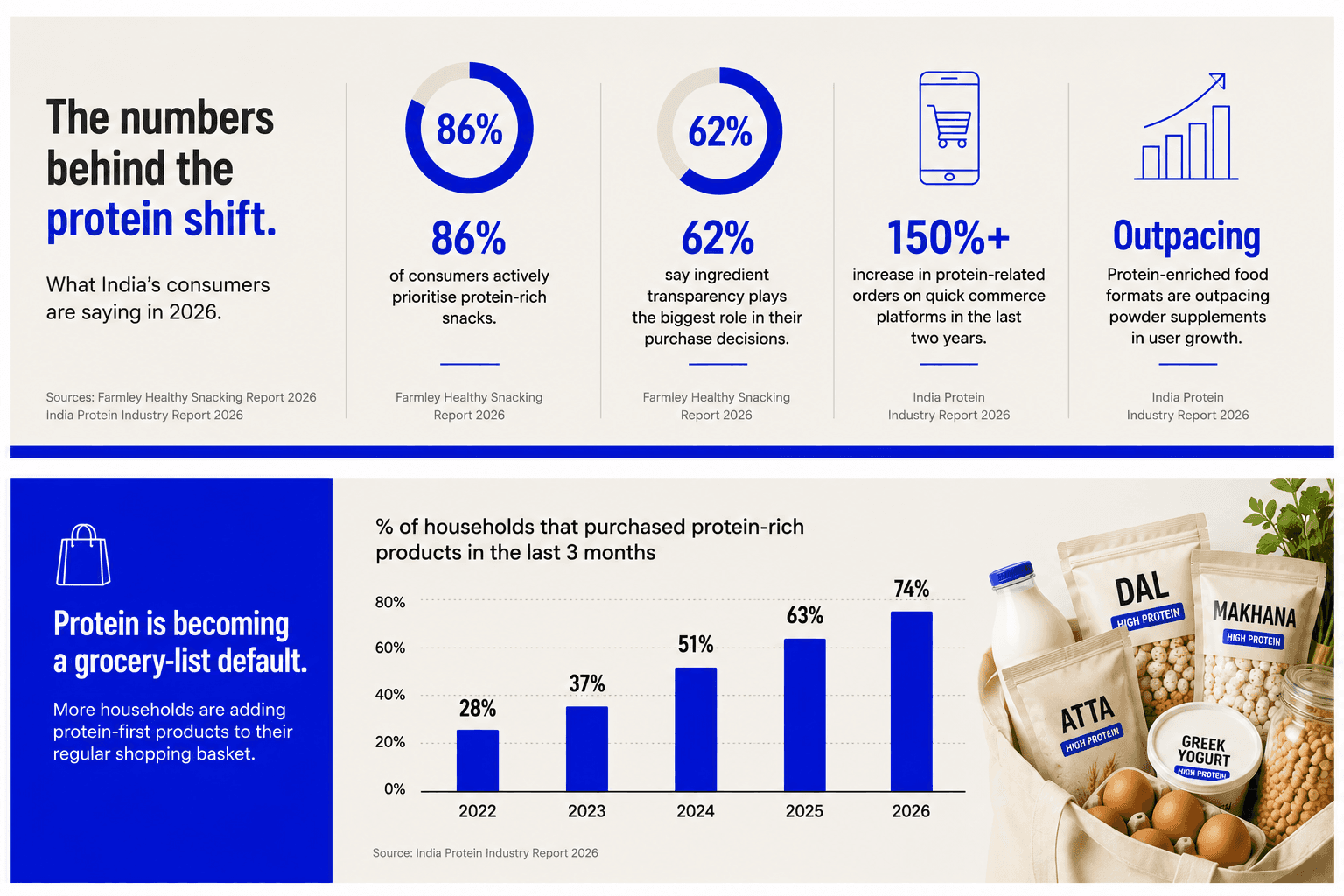
The numbers agree. Farmley's Healthy Snacking Report 2026, based on responses from more than 6,000 consumers across India, found that 86% of consumers now actively prioritise protein-rich snacks, while 62% say ingredient transparency plays the biggest role in their purchase decisions.
Protein has moved from a niche fitness conversation to a grocery-list default. That shift is interesting. But protein itself isn't the story.
Every successful consumer trend follows the same arc. It begins as a point of differentiation, becomes a fast-growing category, and eventually turns into something consumers simply expect. Organic, Natural and Clean label have reached that point.
Protein is entering that phase now.
Walk through any supermarket, or open Blinkit, Zepto, or Instamart today. Your regular packet of dal proudly displays its protein content on the front of the pack. Amul has introduced high-protein lassi and high-protein kulfi. Britannia, ITC, and countless pantry staples have adopted the same language without asking consumers to change what they eat. Collectively, these brands are reshaping how consumers evaluate everyday foods. Protein has moved from a nutritional detail on the back of the pack to one of the first things shoppers notice.
Quick commerce has accelerated that shift further, and the industry data is specific about how. The 2026 India Protein Industry Report describes quick commerce as the pivotal distribution channel for the category, enabling single-unit trials at ₹80–150 that let first-time buyers sample protein without committing to a tub of powder. The same report notes that protein-enriched food formats, ready-to-drink beverages, bars, fortified dairy, biscuits, and fortified atta, are now outpacing powder supplements in user growth. Eggs, paneer, and chickpeas sit in the same basket as protein shakes and bars. Protein isn't confined to the supplement aisle anymore. It's default grocery behaviour.
As more brands enter the category, another shift quietly follows. Once every shelf carries the same claim, "high protein" stops helping consumers choose. It simply becomes something they expect to see. That's where differentiation moves elsewhere.
Over the last year, we've noticed brands pulling one of four levers to stay distinctive.
Some are changing what the ingredient means. Sattu is the clearest example. For decades, it was a traditional household staple, associated with summer drinks and rural kitchens. Today, brands like The Sattu Co. and Brawny Bear introduce it as India's original protein powder, using contemporary branding and modern retail formats to relocate the ingredient in consumers' minds. The ingredient hasn't changed. Its meaning has.
Some are changing how the shelf looks. Makhana has existed for generations, but brands like Farmley, Mr. Makhana, and Open Secret have completely reimagined how it appears at the point of purchase. Premium pouches, sharper design, and stronger shelf presence make a familiar product feel relevant to a very different consumer, without touching the underlying claim.
Some are changing how the brand talks. The Whole Truth has built trust by making nutrition information feel legible instead of intimidating, using plain-language labels, no jargon, and no fear tactics. Yoga Bar has made protein sound like an everyday habit rather than a fitness-enthusiast pursuit. The nutritional promise is similar to competitors'; the register the brand speaks in is not.
Some are changing when and how the product is consumed. Slurrp Farm has folded protein into products families already eat daily, rather than asking them to adopt a new one. Meanwhile cafés and beverage brands, Subko, Blue Tokai Coffee Roasters, and Naario, are experimenting with protein coffees and protein matcha, letting consumers discover the benefit through a ritual they already have, instead of a new one they'd need to build.
The Reuters Report has flagged the same pattern from the manufacturing side. Protein is turning up in ice cream, burger patties, biscuits, and beverages, not just supplements. Consumers are no longer discovering protein in the supplement aisle. They're discovering it inside products they were already buying.

Looking across these brands, one pattern is hard to miss. The nutritional benefit is often similar. What differs is the reason each brand gives consumers to choose it: a different story, a different shelf presence, a different voice, or a different occasion.
Almost none of them are trying to be different in every possible way. Each identified one lever, invested in making it genuinely distinctive, and treated the other three as table stakes, the baseline expected of any credible brand in the category.
That's a more durable way to think about competitive advantage than chasing whichever claim happens to be trending, because every category eventually reaches this point. The biggest point of difference slowly becomes the minimum expectation. And when that happens, growth comes from building distinction somewhere else.
The hardest part is recognising when that shift has already happened to your own brand. After months of shaping every decision, it's easy to assume you're standing apart when customers may simply see you keeping pace with the category.
So before you read this as someone else's category problem: which of the four levers, story, shelf, voice, or occasion, is still open in yours? And which one have you already stopped fighting for, without noticing?
If you want a second opinion, reply with:
Brand name
Category
The one claim almost every brand in your category can now make
In one sentence, what you believe makes your brand different
We'll take a look and tell you honestly whether that difference is still working, or whether it's already become something customers simply expect.
Over the last few months, we've noticed the same conversation showing up in completely different places.
A founder talking about the growing demand for protein-first products. A friend comparing two yoghurt brands based on protein content. Elderly people asking which packet of dal has more protein while grocery shopping.
A few years ago, those conversations would have felt unusual. Today, they barely feel worth pointing out.
The numbers agree. Farmley's Healthy Snacking Report 2026, based on responses from more than 6,000 consumers across India, found that 86% of consumers now actively prioritise protein-rich snacks, while 62% say ingredient transparency plays the biggest role in their purchase decisions.
Protein has moved from a niche fitness conversation to a grocery-list default. That shift is interesting. But protein itself isn't the story.
Every successful consumer trend follows the same arc. It begins as a point of differentiation, becomes a fast-growing category, and eventually turns into something consumers simply expect. Organic, Natural and Clean label have reached that point.
Protein is entering that phase now.
Walk through any supermarket, or open Blinkit, Zepto, or Instamart today. Your regular packet of dal proudly displays its protein content on the front of the pack. Amul has introduced high-protein lassi and high-protein kulfi. Britannia, ITC, and countless pantry staples have adopted the same language without asking consumers to change what they eat. Collectively, these brands are reshaping how consumers evaluate everyday foods. Protein has moved from a nutritional detail on the back of the pack to one of the first things shoppers notice.
Quick commerce has accelerated that shift further, and the industry data is specific about how. The 2026 India Protein Industry Report describes quick commerce as the pivotal distribution channel for the category, enabling single-unit trials at ₹80–150 that let first-time buyers sample protein without committing to a tub of powder. The same report notes that protein-enriched food formats, ready-to-drink beverages, bars, fortified dairy, biscuits, and fortified atta, are now outpacing powder supplements in user growth. Eggs, paneer, and chickpeas sit in the same basket as protein shakes and bars. Protein isn't confined to the supplement aisle anymore. It's default grocery behaviour.
As more brands enter the category, another shift quietly follows. Once every shelf carries the same claim, "high protein" stops helping consumers choose. It simply becomes something they expect to see. That's where differentiation moves elsewhere.
Over the last year, we've noticed brands pulling one of four levers to stay distinctive.
Some are changing what the ingredient means. Sattu is the clearest example. For decades, it was a traditional household staple, associated with summer drinks and rural kitchens. Today, brands like The Sattu Co. and Brawny Bear introduce it as India's original protein powder, using contemporary branding and modern retail formats to relocate the ingredient in consumers' minds. The ingredient hasn't changed. Its meaning has.
Some are changing how the shelf looks. Makhana has existed for generations, but brands like Farmley, Mr. Makhana, and Open Secret have completely reimagined how it appears at the point of purchase. Premium pouches, sharper design, and stronger shelf presence make a familiar product feel relevant to a very different consumer, without touching the underlying claim.
Some are changing how the brand talks. The Whole Truth has built trust by making nutrition information feel legible instead of intimidating, using plain-language labels, no jargon, and no fear tactics. Yoga Bar has made protein sound like an everyday habit rather than a fitness-enthusiast pursuit. The nutritional promise is similar to competitors'; the register the brand speaks in is not.
Some are changing when and how the product is consumed. Slurrp Farm has folded protein into products families already eat daily, rather than asking them to adopt a new one. Meanwhile cafés and beverage brands, Subko, Blue Tokai Coffee Roasters, and Naario, are experimenting with protein coffees and protein matcha, letting consumers discover the benefit through a ritual they already have, instead of a new one they'd need to build.
The Reuters Report has flagged the same pattern from the manufacturing side. Protein is turning up in ice cream, burger patties, biscuits, and beverages, not just supplements. Consumers are no longer discovering protein in the supplement aisle. They're discovering it inside products they were already buying.
Looking across these brands, one pattern is hard to miss. The nutritional benefit is often similar. What differs is the reason each brand gives consumers to choose it: a different story, a different shelf presence, a different voice, or a different occasion.
Almost none of them are trying to be different in every possible way. Each identified one lever, invested in making it genuinely distinctive, and treated the other three as table stakes, the baseline expected of any credible brand in the category.
That's a more durable way to think about competitive advantage than chasing whichever claim happens to be trending, because every category eventually reaches this point. The biggest point of difference slowly becomes the minimum expectation. And when that happens, growth comes from building distinction somewhere else.
The hardest part is recognising when that shift has already happened to your own brand. After months of shaping every decision, it's easy to assume you're standing apart when customers may simply see you keeping pace with the category.
So before you read this as someone else's category problem: which of the four levers, story, shelf, voice, or occasion, is still open in yours? And which one have you already stopped fighting for, without noticing?
If you want a second opinion, reply with:
Brand name
Category
The one claim almost every brand in your category can now make
In one sentence, what you believe makes your brand different
We'll take a look and tell you honestly whether that difference is still working, or whether it's already become something customers simply expect.
Indulgence Is Being Redesigned - Inside India's dessert space.
Indulgence Is Being Redesigned - Inside India's dessert space.
For years, building a better dessert brand followed a familiar playbook. As consumers became more health conscious and lifestyle diseases entered mainstream conversation, brands responded by reducing sugar, adding protein, replacing refined ingredients and positioning indulgence as something you could feel less guilty about.
It was the right strategy for its time, and it created an entire generation of brands.
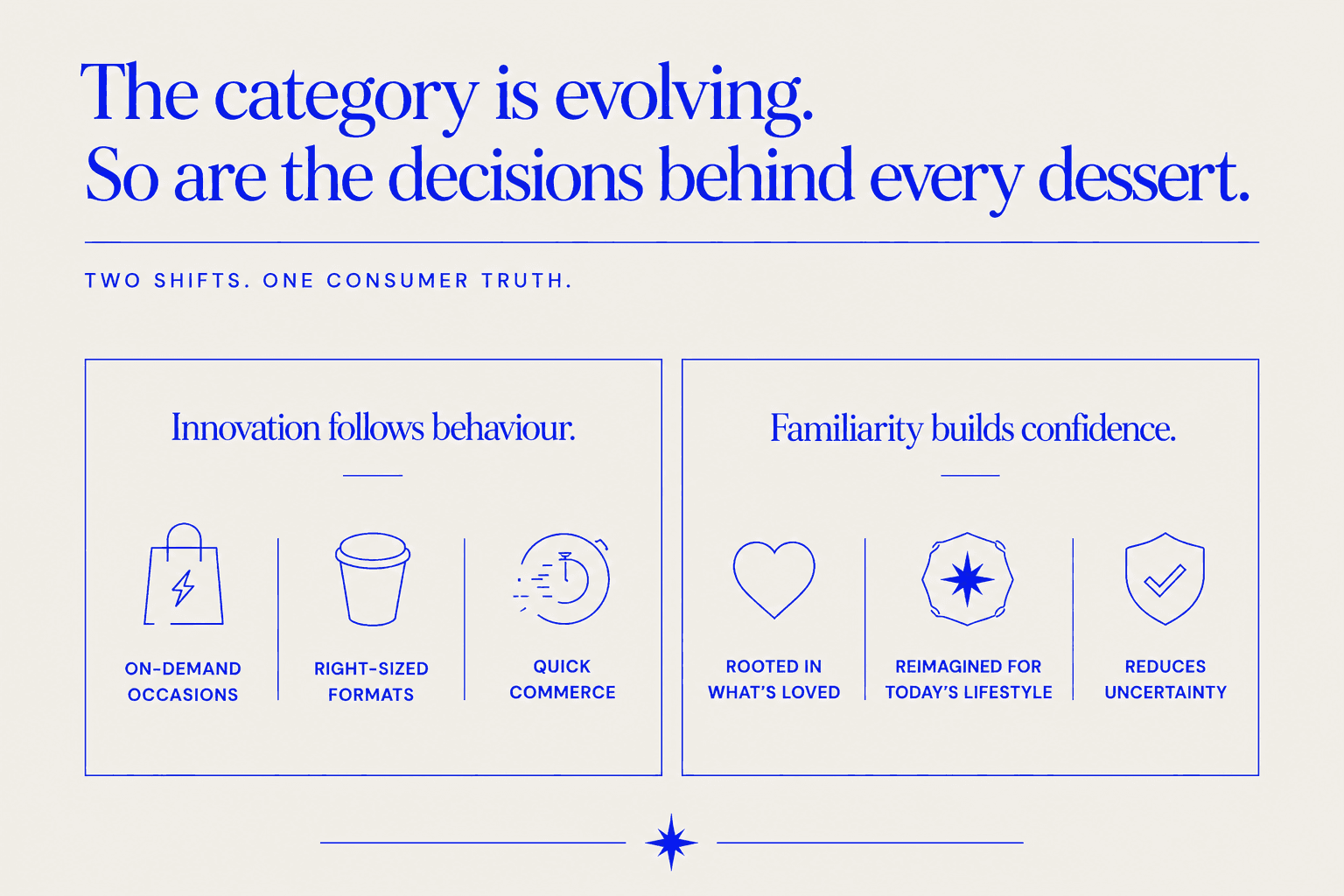
Today, the category is evolving again. Audiences have changed how they decide which ones are worth indulging in. Premium ice creams, artisanal bakeries, celebration-led gifting and better-for-you alternatives are all growing at once. Indulgence remains strong. However, what's changing is how consumers decide which indulgences are worth choosing.
None of these shifts appear particularly significant in isolation. Together, however, they suggest the category is beginning to compete on a very different set of decisions than it did even a few years ago.
As we've spent time studying the space, three observations have consistently stood out.
Observation 01: Consumers are using different signals to decide whom to trust.
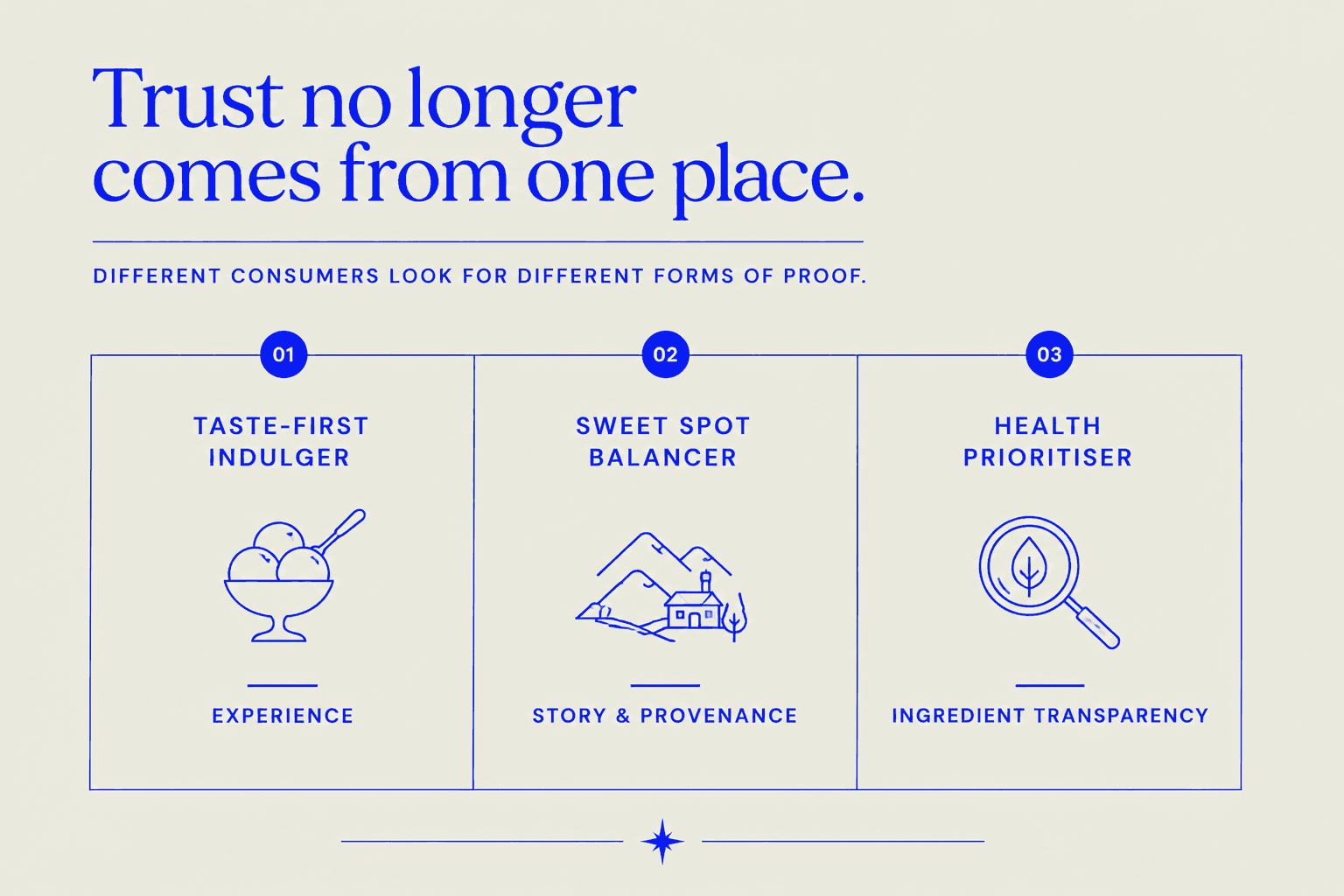
One of the biggest misconceptions in this category is that consumers are gradually becoming more health conscious. Mintel's latest research suggests something more nuanced. Rather than one consumer steadily moving towards healthier desserts, India's market is increasingly made up of three distinct groups: Taste-First Indulgers (38%), Sweet Spot Balancers (26%) and Health Prioritisers (36%). Each group looks for reassurance in a different place before making a purchase.
That changes the way trust should be understood.
Very few people stand in front of a freezer analysing emulsifiers or preservatives. Most purchase decisions happen in seconds, which means the ingredient list is doing a different job. It has become one of several shortcuts consumers use to judge the company behind the product.
The Whole Truth recognised this early. By making ingredients radically easy to understand, it built a trust proposition that has grown into one of India's most valuable emerging food brands, raising a $51 million Series D earlier this year as it prepares for an eventual IPO.
At the same time, the conversation is expanding beyond ingredients alone.
The Godrej Food Trends Report 2026 identifies storytelling as one of the defining shifts shaping Indian food, with provenance, people and regional identity increasingly influencing how consumers evaluate brands. Consumers are no longer responding only to what's inside the pack. They're also responding to where the product came from, who made it and whether the story behind it feels credible.
Viewed together, these shifts suggest that trust is becoming more layered than it was even a few years ago.
Observation 02: Behaviour is becoming a stronger driver of product innovation.
For decades, innovation in desserts was measured by novelty. New flavours, functional ingredients and limited editions became the default way to signal progress. Increasingly, however, the brands gaining momentum are innovating in a quieter but more meaningful way. They're designing products around behaviour people already have, instead of asking them to adopt new ones.
Portion-controlled desserts, individually served cups, mini bars and single-serve formats are becoming more common, not simply because they contain fewer calories, but because they reduce the effort required to stop. Instead of relying on willpower after opening a family pack, the product creates its own natural stopping point.
This is a behavioural design principle more than a nutritional one. People rarely make decisions through perfect self-control. They respond to defaults, convenience and context. The brands gaining momentum recognise these realities and design products that fit naturally within them.
Quick commerce has accelerated this shift even further. Products that were once designed for planned grocery trips are increasingly being built for immediate moments of consumption.
Brands that were once built around weekly grocery baskets are increasingly competing in moments of immediate consumption, where consumers are solving a craving rather than stocking a freezer. That changes everything from portion sizes and packaging to flavour architecture and portfolio design. Products built for one person, one occasion and one decision naturally fit these moments better than formats designed for planned shopping trips because they reduce decision effort precisely when consumers are choosing.
This changes the way founders should think about innovation.
The question is whether the product fits naturally into the way consumers already behave. Brands that align with existing habits require far less persuasion than brands that depend on consumers changing them.
Observation 03: Innovation is shifting from invention to reinterpretation.
For years, standing out meant introducing flavours consumers had never tried. Today, some of the strongest brands are growing by making familiar things feel newly relevant instead of inventing something entirely new.
NIC's growth has leaned on flavours like Tender Coconut, Sitaphal and Malai Kulfi, all recognisable enough to lower the barrier to trying something different. Naturals has built two decades of trust the same way, allowing fruit to remain the hero instead of pursuing novelty for its own sake.
One of the clearest examples of reinterpretation, however, isn't a flavour story. It's a brand story.
Hocco was founded by Ankit Chona, whose family previously built and sold Havmor. Rather than starting from zero, Hocco built on that inherited credibility and reintroduced it as a contemporary brand. Today, it sits comfortably across quick commerce, modern retail and its own pushcart fleet. In under three years, it has grown to approximately ₹532 crore in FY26 revenue and a ₹2,500 crore valuation by positioning itself between legacy trust and a new-age identity instead of choosing one over the other.
That's the pattern worth recognising for founders entering this category. You don't always need a completely new idea. Sometimes the stronger move is identifying what people already trust, whether that's a family name, a regional recipe or a forgotten format, and rebuilding it for how consumers buy today.
The same pattern extends beyond ice cream. Traditional Indian mithai is increasingly appearing as cheesecakes, gelatos and premium gifting formats. The brands creating lasting value aren't using nostalgia as decoration. They're preserving what those desserts already mean to people, family rituals, regional identity and memory, while adapting them to contemporary lifestyles.
Recreating a flavour is easy. Carrying its emotional weight into a new format is far harder. That's precisely what makes it difficult to copy.
A Strategic Lens for Founders
As categories mature, competitive advantage becomes harder to build through product claims alone. It increasingly comes from understanding how consumers make decisions, what gives them confidence and where hesitation enters the buying journey.
If you're building in India's dessert category today, these are the questions worth sitting with before your next product, launch or innovation cycle.
Is your trust currency restraint, or story? Are consumers choosing you because of fewer claims and simpler ingredients, or because of your provenance, people and the story behind the brand?
Are you designing for a grocery decision or a ten-minute craving? Quick commerce didn't just change distribution, it changed product design.
If Gen Z is your growth engine, is your innovation calendar built for the way they discover desserts? Or is it still following a flavour-refresh cadence built for a slower consumer?
Which part of your proposition would still matter if every competitor matched your formulation tomorrow?
The brands that pull ahead over the next few years are unlikely to be the ones with the longest list of claims. They'll be the ones with the clearest answers to questions like these.
Over the past few months, we've been working with an emerging healthy ice cream brand, applying many of these ideas in practice. The work has taken us through category positioning, consumer segmentation, product architecture, portfolio strategy, packaging and brand identity. Throughout the process, we found ourselves returning to the same questions explored in this edition, testing them against real consumer decisions rather than theoretical frameworks.
We'll unpack the strategic decisions and frameworks that shaped the brand, showing how category insights translate into practical choices across product, positioning and design.
Stay tuned.
For years, building a better dessert brand followed a familiar playbook. As consumers became more health conscious and lifestyle diseases entered mainstream conversation, brands responded by reducing sugar, adding protein, replacing refined ingredients and positioning indulgence as something you could feel less guilty about.
It was the right strategy for its time, and it created an entire generation of brands.
Today, the category is evolving again. Audiences have changed how they decide which ones are worth indulging in. Premium ice creams, artisanal bakeries, celebration-led gifting and better-for-you alternatives are all growing at once. Indulgence remains strong. However, what's changing is how consumers decide which indulgences are worth choosing.
None of these shifts appear particularly significant in isolation. Together, however, they suggest the category is beginning to compete on a very different set of decisions than it did even a few years ago.
As we've spent time studying the space, three observations have consistently stood out.
Observation 01: Consumers are using different signals to decide whom to trust.
One of the biggest misconceptions in this category is that consumers are gradually becoming more health conscious. Mintel's latest research suggests something more nuanced. Rather than one consumer steadily moving towards healthier desserts, India's market is increasingly made up of three distinct groups: Taste-First Indulgers (38%), Sweet Spot Balancers (26%) and Health Prioritisers (36%). Each group looks for reassurance in a different place before making a purchase.
That changes the way trust should be understood.
Very few people stand in front of a freezer analysing emulsifiers or preservatives. Most purchase decisions happen in seconds, which means the ingredient list is doing a different job. It has become one of several shortcuts consumers use to judge the company behind the product.
The Whole Truth recognised this early. By making ingredients radically easy to understand, it built a trust proposition that has grown into one of India's most valuable emerging food brands, raising a $51 million Series D earlier this year as it prepares for an eventual IPO.
At the same time, the conversation is expanding beyond ingredients alone.
The Godrej Food Trends Report 2026 identifies storytelling as one of the defining shifts shaping Indian food, with provenance, people and regional identity increasingly influencing how consumers evaluate brands. Consumers are no longer responding only to what's inside the pack. They're also responding to where the product came from, who made it and whether the story behind it feels credible.
Viewed together, these shifts suggest that trust is becoming more layered than it was even a few years ago.
Observation 02: Behaviour is becoming a stronger driver of product innovation.
For decades, innovation in desserts was measured by novelty. New flavours, functional ingredients and limited editions became the default way to signal progress. Increasingly, however, the brands gaining momentum are innovating in a quieter but more meaningful way. They're designing products around behaviour people already have, instead of asking them to adopt new ones.
Portion-controlled desserts, individually served cups, mini bars and single-serve formats are becoming more common, not simply because they contain fewer calories, but because they reduce the effort required to stop. Instead of relying on willpower after opening a family pack, the product creates its own natural stopping point.
This is a behavioural design principle more than a nutritional one. People rarely make decisions through perfect self-control. They respond to defaults, convenience and context. The brands gaining momentum recognise these realities and design products that fit naturally within them.
Quick commerce has accelerated this shift even further. Products that were once designed for planned grocery trips are increasingly being built for immediate moments of consumption.
Brands that were once built around weekly grocery baskets are increasingly competing in moments of immediate consumption, where consumers are solving a craving rather than stocking a freezer. That changes everything from portion sizes and packaging to flavour architecture and portfolio design. Products built for one person, one occasion and one decision naturally fit these moments better than formats designed for planned shopping trips because they reduce decision effort precisely when consumers are choosing.
This changes the way founders should think about innovation.
The question is whether the product fits naturally into the way consumers already behave. Brands that align with existing habits require far less persuasion than brands that depend on consumers changing them.
Observation 03: Innovation is shifting from invention to reinterpretation.
For years, standing out meant introducing flavours consumers had never tried. Today, some of the strongest brands are growing by making familiar things feel newly relevant instead of inventing something entirely new.
NIC's growth has leaned on flavours like Tender Coconut, Sitaphal and Malai Kulfi, all recognisable enough to lower the barrier to trying something different. Naturals has built two decades of trust the same way, allowing fruit to remain the hero instead of pursuing novelty for its own sake.
One of the clearest examples of reinterpretation, however, isn't a flavour story. It's a brand story.
Hocco was founded by Ankit Chona, whose family previously built and sold Havmor. Rather than starting from zero, Hocco built on that inherited credibility and reintroduced it as a contemporary brand. Today, it sits comfortably across quick commerce, modern retail and its own pushcart fleet. In under three years, it has grown to approximately ₹532 crore in FY26 revenue and a ₹2,500 crore valuation by positioning itself between legacy trust and a new-age identity instead of choosing one over the other.
That's the pattern worth recognising for founders entering this category. You don't always need a completely new idea. Sometimes the stronger move is identifying what people already trust, whether that's a family name, a regional recipe or a forgotten format, and rebuilding it for how consumers buy today.
The same pattern extends beyond ice cream. Traditional Indian mithai is increasingly appearing as cheesecakes, gelatos and premium gifting formats. The brands creating lasting value aren't using nostalgia as decoration. They're preserving what those desserts already mean to people, family rituals, regional identity and memory, while adapting them to contemporary lifestyles.
Recreating a flavour is easy. Carrying its emotional weight into a new format is far harder. That's precisely what makes it difficult to copy.
A Strategic Lens for Founders
As categories mature, competitive advantage becomes harder to build through product claims alone. It increasingly comes from understanding how consumers make decisions, what gives them confidence and where hesitation enters the buying journey.
If you're building in India's dessert category today, these are the questions worth sitting with before your next product, launch or innovation cycle.
Is your trust currency restraint, or story? Are consumers choosing you because of fewer claims and simpler ingredients, or because of your provenance, people and the story behind the brand?
Are you designing for a grocery decision or a ten-minute craving? Quick commerce didn't just change distribution, it changed product design.
If Gen Z is your growth engine, is your innovation calendar built for the way they discover desserts? Or is it still following a flavour-refresh cadence built for a slower consumer?
Which part of your proposition would still matter if every competitor matched your formulation tomorrow?
The brands that pull ahead over the next few years are unlikely to be the ones with the longest list of claims. They'll be the ones with the clearest answers to questions like these.
Over the past few months, we've been working with an emerging healthy ice cream brand, applying many of these ideas in practice. The work has taken us through category positioning, consumer segmentation, product architecture, portfolio strategy, packaging and brand identity. Throughout the process, we found ourselves returning to the same questions explored in this edition, testing them against real consumer decisions rather than theoretical frameworks.
We'll unpack the strategic decisions and frameworks that shaped the brand, showing how category insights translate into practical choices across product, positioning and design.
Stay tuned.
A weekly story tracing the history, consumer behaviour, and patterns behind brands and businesses that last.
Office 202, 2nd Floor, Baron Centre,
North Avenue, Kalyani Nagar, Pune, Maharashtra, India. 411006

A weekly story tracing the history, consumer behaviour, and patterns behind brands and businesses that last.
Office 202, 2nd Floor, Baron Centre,
North Avenue, Kalyani Nagar, Pune, Maharashtra, India. 411006
A weekly story tracing the history, consumer behaviour, and patterns behind brands and businesses that last.
Office 202, 2nd Floor, Baron Centre,
North Avenue, Kalyani Nagar, Pune, Maharashtra, India. 411006
A weekly story tracing the history, consumer behaviour, and patterns behind brands and businesses that last.
Office 202, 2nd Floor, Baron Centre,
North Avenue, Kalyani Nagar, Pune, Maharashtra, India. 411006
A weekly story tracing the history, consumer behaviour, and patterns behind brands and businesses that last.
Office 202, 2nd Floor, Baron Centre,
North Avenue, Kalyani Nagar, Pune, Maharashtra, India. 411006